
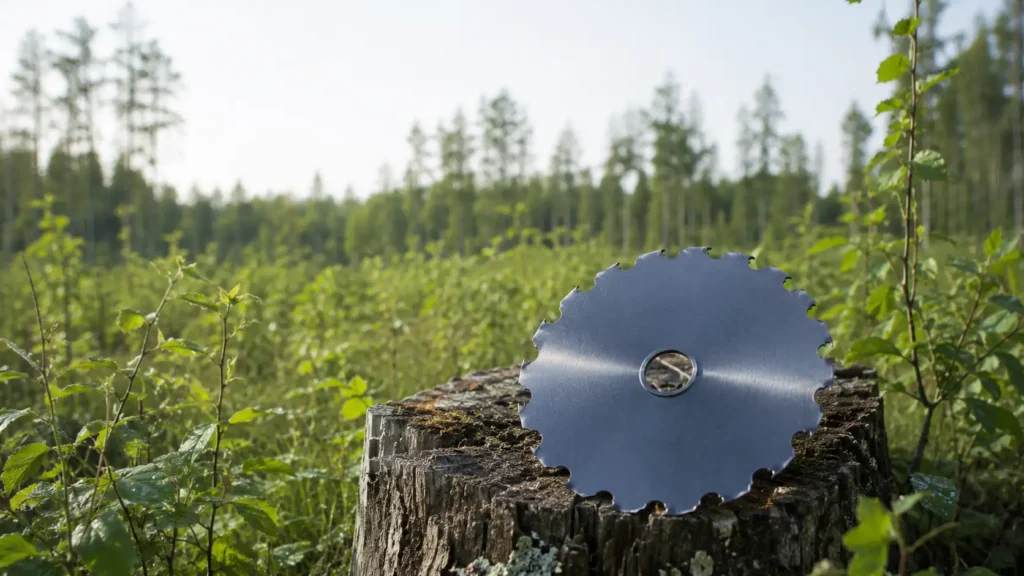
Clearing brushwood can involve anything from removing thin annual shoots along a roadside to working through dense vegetation with thicker stems. Therefore, there is no single brush cutter blade that is optimal for every type of brush clearing.
The right brush cutter blade for brushwood depends on factors such as the thickness of the vegetation, how densely it grows, the terrain, and the scale of the work. A blade that performs well in light vegetation may not be the best choice once the brushwood becomes thicker and more woody.
In this guide, we explain what to consider when choosing a brush cutter blade for brushwood and how to match the blade to the task.
What is brushwood?
Brushwood is a general term for young trees, shrubs, and other woody vegetation that often grows densely in places such as:
- Forest land
- Pastures
- Roadsides
- Power line corridors
- Ditches
- Residential plots
- Overgrown land
- Clear-cuts and plantations
Common examples include young shoots and smaller stems of birch, aspen, alder, and various shrub species.
Brushwood can therefore vary considerably in both height and diameter. Thin, soft brush does not place the same demands on a brush cutter blade as dense stands with thicker, woody stems.
The first step when choosing a blade is therefore to assess what type of vegetation you actually need to clear.
Which brush cutter blade is best for brushwood?
For woody brushwood, a toothed brush cutter blade designed to cut smaller stems efficiently is commonly used.
However, the choice should not be based solely on whether the vegetation is brushwood or not. Also consider:
- The diameter of the stems
- How densely the brushwood grows
- How hard the wood is
- How much contact with the ground may occur
- How many hours you will be working
- Which brush cutter the blade will be mounted on
The thicker and denser the vegetation, the more important the blade’s cutting performance, stability, and ability to retain its sharpness during use become.
Thin brushwood requires an agile blade
If the area mainly consists of thin shoots and smaller shrubs, it is often more important to be able to work quickly and smoothly than for the blade to be designed to cut thicker stems.
For lighter brush clearing, you can for example use:
- Young shoots
- Thin shrub stems
- Small self-seeded trees
- Mixed light vegetation
Here, a lightweight and efficient brush cutter blade is often a good choice.
The goal is for the blade to cut through the vegetation quickly without requiring you to stop at each stem.
Thicker brushwood places greater demands on the blade
When brushwood has been allowed to grow for several years, the stems can become significantly thicker and more woody. At that point, the work begins to resemble traditional forestry clearing.
A brush cutter blade for thicker brushwood needs to handle repeated cutting without making the work unnecessarily strenuous.
This is particularly important if you are working with:
- Dense stands of birch brushwood
- Thicker shrubs
- Young trees
- Overgrown woodland areas
- Brushwood that has been left to grow for several years
Here, a well-sharpened toothed blade becomes significantly more important.
If the blade is dull, you will notice it quickly. You need to apply more force, and it takes longer to cut through each stem.
Dense brushwood or individual stems?
How the vegetation grows also plays an important role.
Dense brushwood
When the stems are very densely spaced, the blade needs to be able to work continuously. Efficient cutting becomes important, as otherwise you can quickly lose momentum.
In dense stands, this can involve hundreds of cuts during a single work session.
A sharp brush cutter blade suited to the vegetation can therefore make a significant difference to the workflow.
Individual thicker stems
If the ground is relatively open but contains occasional thicker brushwood stems, the requirements are different.
In that case, it is less important to cut large volumes of thin vegetation quickly and more important that the blade can handle thicker woody stems in a controlled manner.
This shows why the same type of blade is not always optimal for every type of brush clearing.
Mixed vegetation requires greater versatility
Many areas do not consist solely of brushwood.
For example, you may have a mixture of:
- Tall grass
- Weeds
- Thin shrubs
- Brushwood
- Small tree stems
If the vegetation varies considerably, a more versatile blade can be a practical choice.
Alternatively, choose the blade based on the type of vegetation that makes up the majority of the work.
For example, if you will mainly be cutting woody brushwood, the blade should primarily be designed for that purpose, even if the area also contains grass and other soft vegetation.
The terrain affects the choice of brush cutter blade
It is easy to focus entirely on the vegetation when choosing a blade, but ground conditions are just as important.
A brush cutter blade used on level forest ground is subjected to different stresses than a blade used on rocky terrain.
Clearing on rocky terrain
Stones increase the risk of more severe blade wear or damage.
If you regularly work near:
- Stones
- Rock
- Gravel
- Roadsides
- Ditches
- Hard ground surfaces
this should be taken into account when choosing the type of blade.
It is also important to work in a way that minimizes unnecessary contact between the blade and the ground.
Clearing close to the ground
When clearing very close to the ground, the risk of the blade hitting soil and sand increases.
Even without direct contact with larger stones, soil can contain abrasive particles that cause the cutting edge to lose sharpness more quickly.
Therefore, try to avoid using the ground itself as a height reference for the blade.
Brush cutter blade or grass blade for brushwood?
A common question is whether to use a toothed brush cutter blade or a simpler grass and brush blade.
It mainly depends on the type of vegetation.
A grass blade can work well for soft vegetation and very thin brushwood, while a toothed brush cutter blade is generally the more suitable choice once the vegetation has become clearly woody.
A simple way to think about it is:
The more the vegetation resembles small trees rather than tall grass, the stronger the case for choosing a brush cutter blade designed for woody vegetation.
At the same time, always check which blade types your brush cutter is approved for.
What size brush cutter blade should you use?
The size of the blade must always be compatible with the brush cutter and follow the machine manufacturer’s recommendations.
A larger blade is not automatically better.
The blade diameter affects factors such as:
- The load on the machine
- The peripheral speed
- The working area
- How the brush cutter feels to operate
Therefore, you should not choose the blade size based solely on how thick the brushwood is that you need to cut.
Always check the brush cutter’s specifications and which blade dimensions and mounting types are approved for your specific machine.
The number of teeth affects the blade’s characteristics
Brush cutter blades are available with different tooth geometries and numbers of teeth.
More teeth do not automatically mean that the blade is better. The blade’s design must be considered as a whole.
Factors that affect cutting performance include:
- Tooth shape
- Tooth angle
- Tooth set
- Blade diameter
- Material
- Sharpening
- Number of teeth
It is therefore better to choose a blade designed for the specific task rather than focusing on a single technical specification.
A sharp blade is more important than many people realize
Even a high-quality brush cutter blade performs worse once the teeth become dull.
When the blade loses its sharpness, you may notice that:
- Cutting becomes slower
- The blade no longer passes through the stem as easily
- You begin to use more force
- The work becomes less controlled
- The brushwood is not cut as cleanly
Therefore, check the blade regularly during longer work sessions.
A file-sharpenable blade may need maintenance when its cutting performance begins to deteriorate. Other types of blades may require specialized sharpening equipment.
Always follow the recommendations for the blade you are using.
Choose the blade based on how much clearing you do
There is also a difference between clearing brushwood once or twice a year and working with brush clearing several days a week.
For smaller clearing jobs
If you only need to clear a small area around a property, ease of use and versatility are often the most important factors.
For regular clearing work
If you regularly clear larger areas, factors such as cutting performance, ease of maintenance, and durability become more important.
For professional clearing work
With many hours of use, small differences in a blade’s characteristics can become significant over time.
In that case, the blade should be selected based on the vegetation, the machine, the working method, and the environments in which it will be used.
How to choose a brush cutter blade for brushwood – simple checklist
Before choosing a blade, ask yourself the following questions:
1. How thick is the brushwood?
Thin shoots and thicker young trees require different blade characteristics.
2. How densely does the vegetation grow?
Dense brushwood involves many cuts and places greater demands on efficiency.
3. Is there a lot of grass and soft vegetation?
If the area contains several types of vegetation, a more versatile solution may be suitable.
4. Is the ground rocky?
Working near stones and hard materials can affect which type of blade is the most practical choice.
5. How much clearing will you be doing?
For extensive or professional clearing work, the blade’s durability and cutting performance become more important.
6. What does the brush cutter manufacturer recommend?
The blade diameter, arbor hole, mounting system, and design must be compatible with the machine.
By answering these questions, it becomes much easier to choose the right blade.
Different blades for different types of brush clearing
There is therefore no single brush cutter blade that is best for every situation.
For light vegetation, agility and versatility may be especially important. With thicker brushwood, efficient cutting of woody stems becomes more important, while abrasive or rocky environments may require additional blade characteristics to be prioritized.
If you want to compare different options, you can explore Strand’s range of brush cutter blades for different types of clearing work and working environments.
The most important thing is to base your choice on the vegetation and terrain where the blade will actually be used.
Don’t forget maintenance
Choosing the right blade is only part of the equation.
To maintain good cutting performance, you should also:
- Inspect the blade regularly
- Keep it clean from resin and dirt
- File or sharpen it according to the manufacturer’s instructions
- Inspect it after contact with stones
- Replace the blade if it has become damaged or heavily worn
- store the blade in a dry, protected place
Regular maintenance also makes it easier to detect damage before the next work session.
Conclusion
When choosing a brush cutter blade for brushwood, you should primarily consider the thickness of the vegetation, how densely it grows, and the terrain you are working in.
For thin brushwood and mixed vegetation, versatility can be important. As the stems become thicker and more woody, the demands on the blade’s cutting performance increase. On rocky or abrasive ground, you also need to consider how the working environment affects the blade.
Remember that even the right blade needs maintenance. A sharp and well-maintained brush cutter blade provides better conditions for efficient and smooth work than a blade that has become heavily worn.

 English
  Svenska